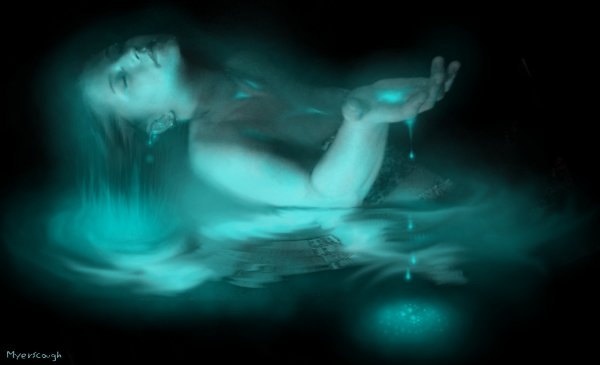
How to photograph the Bioluminescent Bay
The bio bay can be photographed easily with a very light-sensitive digital camera, or very sensitive film (3200 or faster) and a fast lens: the faster the better. I was actually shocked at how simple it really was.
Exposure and flash
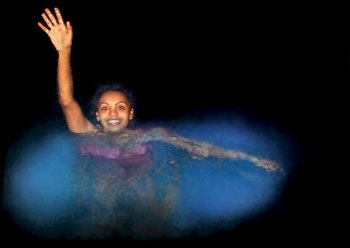
You need exposures of sixteen seconds or longer, with the aperture wide open (the lowest possible number), on a tripod, with a half-power fill flash aimed at the subject at some point during the exposure. Extra-long exposures give a brighter glow, but the subject tends to be lost in it, the glow looks nothing like the real thing, and the photos look contrived.
A full-power flash can also give good results, but you risk washing out the glow or creating distracting reflections in the ripples on the water. If you use a brighter flash, make sure your angle to the water isn’t too straight down, or the shot will be ruined. The photo above needed some retouching to remove reflected light from the flash and to put the hair back on my model, Betsy: her black hair didn’t reflect any light. I made her look bald, and I was sure she would kill me the next time she saw me.
Keep the subject still
Keep your subject in exactly the same spot during the exposure. The longer the exposure, the brighter the glow, but to keep the glow looking like the real thing, don’t overexpose. Stabilize your model so he or she doesn’t move: prop them up from beneath, hold their feet, or have them stand or sit on the bottom close to shore.
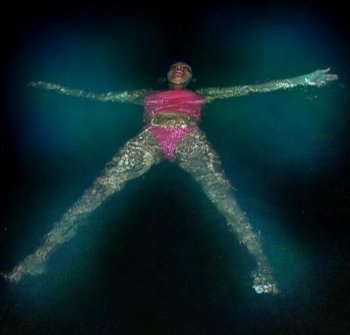
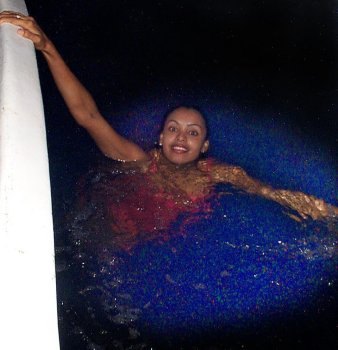
Fully automatic cameras will not work, but real photography bugs will have a great time, and it’s not that difficult to figure out. We rented the boat and skipper for only an hour and a half. If possible, choose a night with no moon: some of these shots were taken while the moon went behind a cloud for a few minutes, and the rest on a later trip. Double exposures also work well: take a flash photo first, then a no-flash time exposure without moving the tripod, and put them together.
Working on the computer
I suggest a good digital camera, because you can see immediately whether you have the shot, and it’s easy to punch up the image on the computer. You can enhance the glow without overexposing the rest of the photo by lightening only the glow, although its color will tend to change. The color deepens and digitizes, but it can be corrected if you want to spend the time. I have noticed that the shorter the exposure, the deeper the blue of the glow; the true color is a light blue-green.
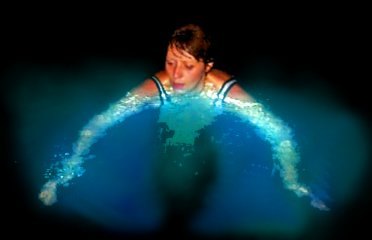
You can enhance the color of the glow even more by adjusting the color saturation after you download the photos, if you have a program that will do it. It does make the subject redder and the glow a deeper blue than in reality, so be careful not to overdo it. I enhanced the skin tone in the photo above separately to bring it back closer to normal; anyone with a good photo-editing program can do the same.
What the camera can’t catch
I haven’t been able to find a camera fast enough to capture the incredible fluidity of the glow as it looks in any given instant. Long exposures are only a matter of leaving the shutter open, and they give some interesting effects, but they are nothing like the experience of the bay: just people flapping their arms and legs, making a glow on film that looks nothing like the real thing. The true experience of the bio bay is much more subtle, ethereal and infinitely more beautiful.
Someday, as digital imaging becomes more sensitive, someone will take a stop-action still photograph that really captures the magic of this place. Like the aurora borealis before high-speed film, the emotional presence, the true color and the true feel of the bioluminescent bay are still better represented by the artist than by the photographer.